
Juvenile Release Paths Stay Private
The Kentucky Department of Juvenile Justice operates Fayette Regional Juvenile Detention Center. A youth may return to a guardian or community under a court-approved plan, transfer to another DJJ or court placement, or remain under juvenile supervision. Physical departure from one building does not reveal whether the youth’s legal custody or supervision ended.
Kentucky juvenile proceedings and records carry confidentiality restrictions. The adult Fayette Current Jail Population, KDOC’s KOOL system, and public adult release pages must not be used to infer where a youth is held or whether a youth has been released. They cover different populations and legal systems.
Confidentiality boundary: no public youth-identifying release search is offered here. Eligible people must contact DJJ, counsel, or juvenile court.
Confirm an Authorized Juvenile Release
Only an eligible requester should seek case-specific information. Authorization may arise from being a parent, guardian, attorney, party to the proceeding, or another person recognized by DJJ or the court. The agency or court determines what can be confirmed and what proof of identity or authority is required.
- Contact the youth’s attorney or assigned DJJ professional when known.
- State the requester’s relationship and legal authority.
- Provide identifying facts through the secure channel the office instructs.
- Ask whether the youth returned to a guardian, moved to another placement, or remains supervised.
- Follow the court or DJJ process for any record copy that may lawfully be released.
Do not send sensitive youth facts through an unrelated adult search form. A lack of public results is expected and should not be treated as proof of release, detention, transfer, or case closure.
Juvenile Court Record Route
The Fayette District Court information page is the public starting point for local court routing. It does not turn a confidential juvenile matter into an open adult record. Court staff can explain the correct filing desk, access process, or proof required, but they may be unable to disclose case facts to an unauthorized caller.
When an order governs release or placement, the court record establishes legal authority. DJJ or the receiving guardian or placement confirms what physically occurred. Those are distinct questions. A court direction may exist before transportation and intake steps are finished.
The matching source capture shows the official court route. Check Fayette District Court information for current routing.
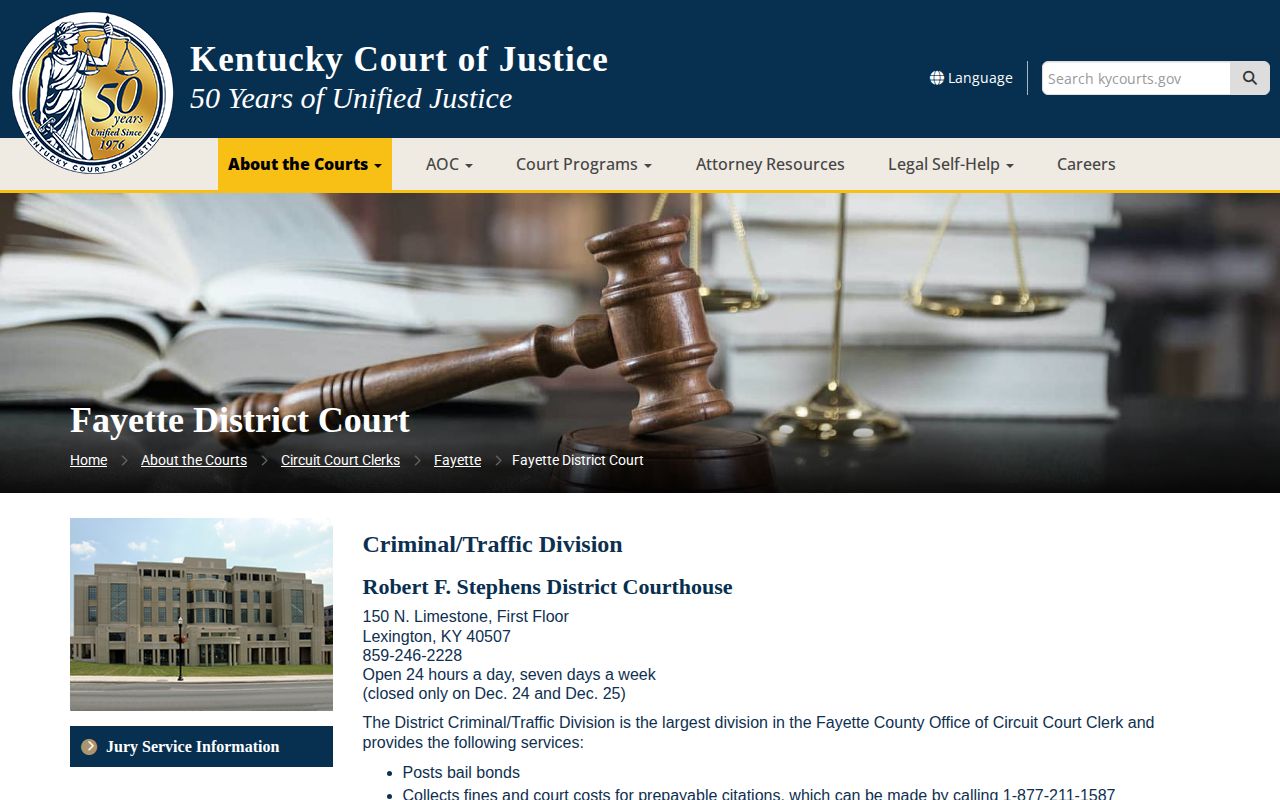
The court page is a contact path, not a public list of youth placements or release identities.
Fayette Juvenile Facility Facts
The official DJJ description identifies a high-security male juvenile detention center with capacity for 56 youth, constructed in 2005. Capacity and security level describe the institution. They do not establish current occupancy, identify any youth, or disclose an individual release.
The facility appears in Fayette’s map to prevent families from being sent to Community Corrections, which operates the adult jail. Its presence does not authorize conversion of protected juvenile data into adult released-inmate content.
Juvenile Records and Images
Juvenile identity, placement, medical, educational, safety, and court information may be protected. Kentucky’s Open Records Act also contains exemptions, and a public-record request cannot override a confidentiality rule or sealed court process. An agency may withhold protected material or release only a segregable portion when law permits.
Booking or placement photographs of youth should not be sought through adult mugshot channels. Do not use an adult roster, KOOL photo, registry, news image, or commercial source to guess that a youth was housed here. An image does not establish present custody and can expose a protected person to harm.
- Placement
- A location or program chosen under DJJ or court authority.
- Supervision
- Ongoing legal oversight that may continue outside a secure building.
- Release
- A custody change whose scope depends on the governing juvenile order.
- Authorized requester
- A person whose role and proof satisfy DJJ or court access rules.
Adult Systems Do Not Apply
Fayette County Detention Center serves the ordinary local adult custody role. Blackburn Correctional Complex is a state adult prison. Federal Medical Center Lexington belongs to BOP. Each has an adult or federal lookup path, but none is a substitute for a DJJ or juvenile-court inquiry.
The Fayette County adult release search should be used only for the adult systems it describes. If an adult portal returns no match for a youth, stop. Do not widen the search through public photo or data sites. Contact an authorized professional who can protect the youth’s information while giving lawful guidance.
Authorized Juvenile Request Preparation
An eligible requester can prepare for a DJJ or court contact without exposing youth information in public. Gather the requester's identification, proof of relationship or authority, counsel's contact information, and any case reference already lawfully held. Ask which secure method the office accepts before sending a birth date, address, medical fact, school fact, or placement detail.
Frame the question narrowly. A guardian may need to know whether and when custody returned, what order governs the next placement, which office supervises the youth, or how to obtain an order the guardian is entitled to receive. The office may verify identity, limit the response, refer the requester to counsel, or require a filing. Those controls protect the youth and the proceeding.
If the requester lacks authority, the correct result may be no disclosure. That is not evidence that the youth remains detained or was released. Do not fill the gap with social media, adult databases, image matching, or guesses based on a missing name.
Juvenile Placement Is Not Discharge
A placement change can look like release from one building while legal oversight continues. The youth might return to a guardian under conditions, enter a program chosen by DJJ or the court, transfer to another secure setting, or move into a less restrictive placement. Only the governing order and authorized agency record can explain it.
| Event | Possible meaning | Correct source |
|---|---|---|
| Return to guardian | Community placement with terms | DJJ, counsel, court order |
| Facility transfer | Custody continues elsewhere | Authorized DJJ contact |
| Program placement | Oversight may continue | Placement order |
| Case closure | Proceeding reaches an endpoint | Juvenile court |
Adult terms can mislead. KOOL parole, adult probation, BOP supervised release, and county-jail bond are not default labels for a juvenile case. Use the language in the youth's order and ask counsel to explain unfamiliar terms.
Protect Youth Release Information
Share case-specific facts only with people authorized to receive them, using the secure channel supplied by DJJ, counsel, or the court. Avoid posting a youth's name, photograph, location, schedule, or placement plan in public.
If safety or immediate welfare is at issue, use the suitable emergency or professional channel, not an adult search. Court staff can route procedure but cannot give legal advice. Counsel can interpret the order. DJJ can address placement and supervision within lawful access.
Authorized Juvenile Record Differences
A court order, DJJ placement record, and facility movement record may describe the same transition from different points of view. The order states legal authority. DJJ records the placement and supervision path. A facility record may show when physical movement took place. An eligible requester should ask which document answers the exact question instead of seeking a broad public file.
Timing can differ. The court may enter an order before transportation or guardian handoff is complete. A new placement may begin while court oversight continues. Return to a guardian may carry conditions. None of those facts should be inferred from an adult roster, an absent search result, or a public photograph.
If a record copy is permitted, the office may redact protected facts about the youth or other people. A limited response does not mean the agency lacks the rest of the record. It reflects the confidentiality rules that govern access. Counsel can help an authorized party understand an order and seek review through the correct court process.