
Fayette Three-Day Release Records
The Lexington-Fayette Urban County Government Division of Community Corrections operates Fayette County Detention Center. Its public inmate-information route supports current-custody checks. It does not advertise a rolling 72-hour release list, a former-inmate archive, a release-date filter, an update cadence, or a fixed period during which released names stay online.
A three-day view therefore begins with a defined date range, not a public feed. Ask Community Corrections whether an existing releasable log covers the exact start and end timestamps. The request should seek a record already kept in the ordinary course of business. It should not instruct the city to research cases or create a new 72-hour report.
The distinction protects the accuracy of the result. A current roster answers who is listed now, while a release log records completed transactions during a period. Comparing snapshots of the current roster cannot reliably recreate that log. A person may leave one snapshot because of a transfer, data correction, court movement, or temporary feed behavior, and another person may be booked and released between checks without appearing in either snapshot.
Check Fayette Releases Over 72 Hours
Define the period first, including start and end times. That makes a records request clear and allows later comparison with VINE or court entries. Use the Jail Releases: 24 Hours route instead when the question is limited to a same-day event.
- Check the official Fayette current jail population and note the retrieval time. A matching entry supports present local custody only.
- Search Kentucky VINE for each named person and compare identifiers. A not-in-custody record with a release date is stronger evidence than absence from the jail roster.
- Call Community Corrections at (859) 425-2700 for the correct status or records channel when timing matters.
- File an LFUCG open-record request for an existing release log covering the precise three-day timestamps, preferably in its native electronic format.
- For one person, request the booking episode’s release date and time, disposition or destination, and booking sheet.
- Check the court case for the legal order, then search KOOL, BOP, ICE, or another county if the record points to a transfer.
This method can assemble a documented three-day picture. It does not turn VINE into a countywide list because VINE searches and notifications are tied to a specific person.
Fayette 72-Hour Record Fields
No public Fayette feed guarantees a set of release columns. The field table below describes useful items to seek in an existing release log or in individual booking episodes. Community Corrections may withhold, redact, or report that a field or report is not maintained.
| Requested field | Purpose in a three-day review |
|---|---|
| Name and identifiers | Separates people with similar names and ties records to the right person. |
| Booking number | Connects the release entry to one local jail episode. |
| Booking date and time | Shows when that episode began, which may predate the window. |
| Release date and time | Places the recorded departure or handoff inside or outside the period. |
| Release reason or disposition | Identifies bond, time served, probation, dismissal, court order, or another basis when recorded. |
| Case or authority | Points to the court file or order that explains legal authorization. |
| Destination or receiving agency | Distinguishes community release from continued custody after transfer. |
Request a booking photograph separately if it is needed as part of the episode record. Do not assume a current profile photo is a released-person gallery entry.
Fayette Weekend Release Windows
A 72-hour range is useful when a same-day check would split events across Friday, Saturday, Sunday, or a holiday. Yet the research found no public Fayette weekend release schedule, fixed gate time, release door, or guaranteed posting interval. A court order may be entered before the jail finishes its checks, and an online custody status may change after the physical event.
Release authority and actual departure are separate facts. Bond, recognizance, dismissal, sentence credit, probation, or another order can authorize release. An unresolved warrant, detainer, or transfer can prevent release to the community. Record exact timestamps from each source and allow for the possibility that a legal order and jail transaction fall on different calendar days.
For weekend review, avoid asking only for people whose court order falls in the period. Instead, seek the existing jail transactions whose recorded release or transfer time falls within it. If the city reports that no such log is maintained, request each known booking episode. That narrower request can still establish what happened without requiring staff to create a new report.
Note: Use exact timestamps in the request so the three-day window does not become an unclear calendar-date estimate.
Fayette 48-Hour Booking Page
The public jail interface offers “Current Jail Population” and “Booked in the Last 48 Hours.” Neither is a 72-hour release list. The rolling booking page reports admissions and may show a photo, name, inmate ID, birth date, race, sex, height, weight, and an expected-release value when one is populated. That forecast may be blank and never proves the jail completed a release.
The official inmate-information portal makes the current-custody scope visible.
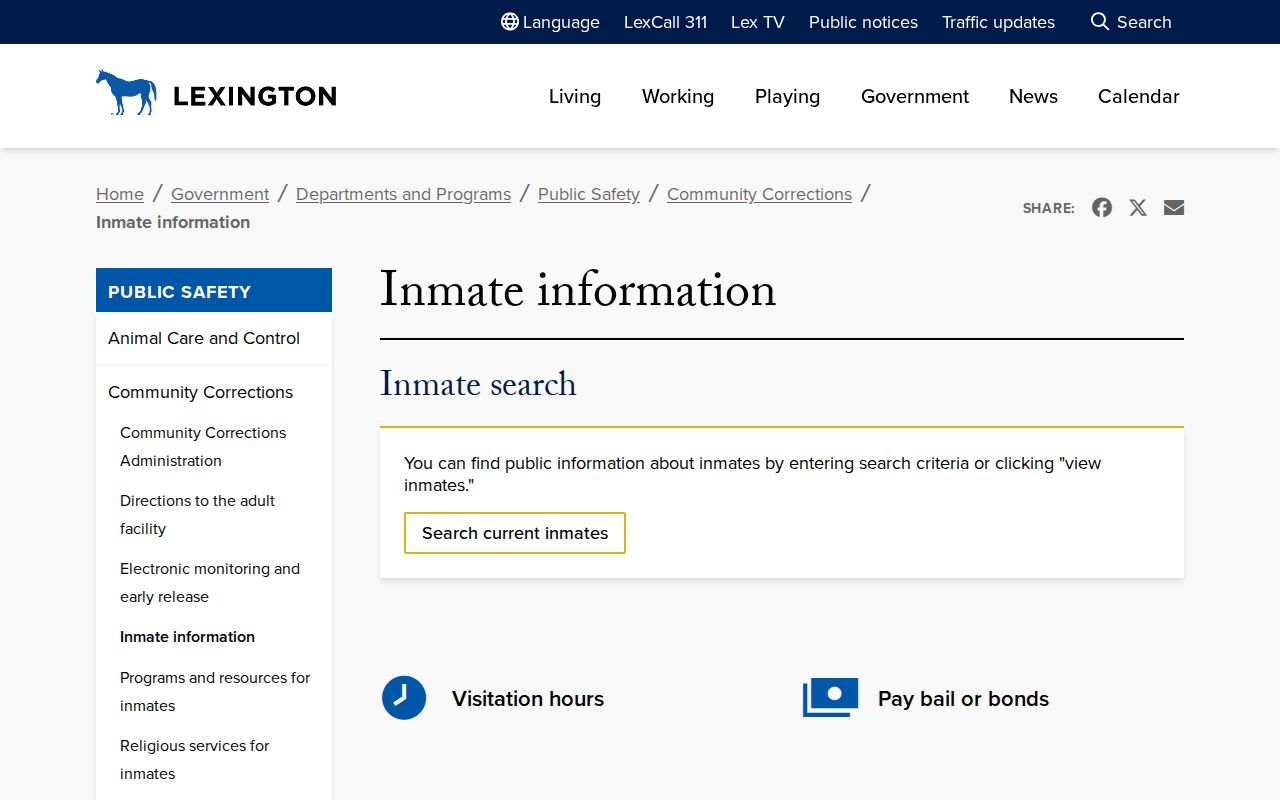
This official page is the starting point for present local custody, not an archive of former inmates. The authenticated felony-release report identified during research is a law-enforcement function, so public users must use VINE, courts, or open records instead.
KDOC Releases Are a Separate List
Kentucky Department of Corrections publishes a Daily Releases archive with dated reports and historical month groupings. It is a valuable statewide exception to the lack of a Fayette public jail feed. Still, it covers KDOC releases, not every person who leaves Fayette County Detention Center. Someone released from Blackburn Correctional Complex or another Kentucky prison belongs in the state route, while a local bond release belongs with Community Corrections and the court.
The KDOC Daily Releases archive shows the state report access point.
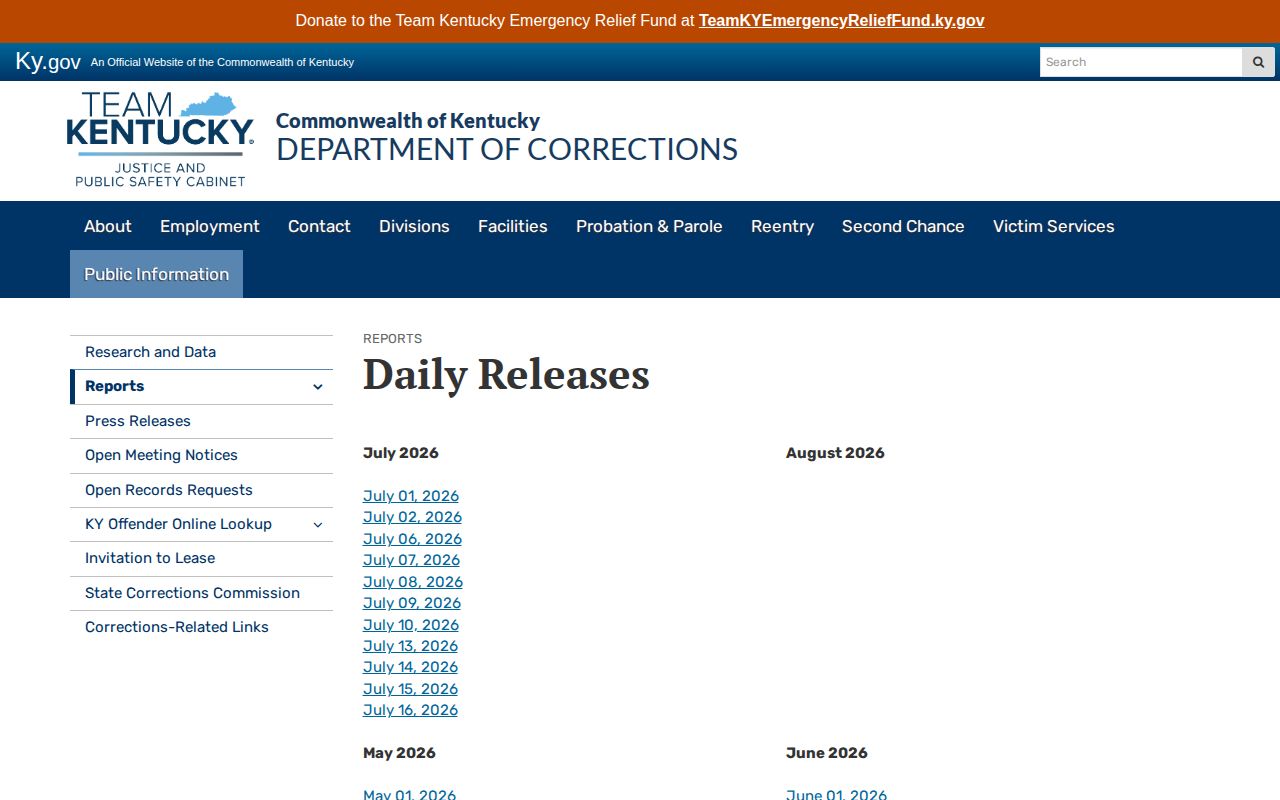
Inspect the chosen dated report before describing its columns. State reports should not be merged into a purported Fayette jail list because the agencies, custody events, and populations differ.
Fayette Release Versus Transfer
A person absent from the Fayette roster may have entered the community, but the same absence can follow a transfer to KDOC, another county, the U.S. Marshals Service, BOP, ICE, or a treatment placement. Check the destination field in the release transaction. Then confirm continuing custody in the receiving system.
KOOL covers state prisoners and many people on Kentucky probation, parole, or Mandatory Reentry Supervision. A prison location means incarceration; a Probation and Parole district may show community supervision rather than unconditional discharge. A BOP result showing “Released” with a date supports a federal release, while an institution or Residential Reentry Management designation means federal custody continues.
Verify Fayette Three-Day Results
For one named person, the strongest result pairs two sources. Match a VINE or jail release date with the court order, or match KOOL release or supervision information with the parole or reentry record. The court file explains the legal authority, but it may not show the physical gate-out time. The jail transaction can show departure or destination, yet the legal reason may be clearer in the docket. Read them together.
If sources conflict, rely on the office that created the disputed record and ask it to clarify or correct the entry. Save the booking number, case number, retrieval time, and exact labels shown. “Projected,” “expected,” and “proposed” dates are forecasts or decision-stage terms, not actual release events. A parole recommendation can still require conditions and final processing before departure.
The broader Fayette released-inmate lookup explains how each county, state, juvenile, and federal facility routes its releases. Juvenile placements must not be inferred from adult public systems. Fayette Regional Juvenile Detention Center records generally remain confidential and require an authorized DJJ or juvenile-court channel.
No public sheriff or Community Corrections mobile app was found that advertises recent releases. Kentucky VINE web and notification access is the supported substitute for following a specific person, not a way to browse everyone released in the three-day span. A VINE transfer message means custody changed. It should not be rewritten as community release without confirmation from the destination record.