
Fayette Release Systems Stay Separate
County and state records may describe the same person at different stages. A Fayette detainee can leave the local jail by transfer to KDOC and remain confined. The local transaction then marks the end of county custody, while KOOL carries the state sentence projection. A transfer date is not release to the community.
A federal date requires another caution. BOP locator results may show a release date and “Released” for a historical federal record, but BOP warns that dates may not be current and some older records are absent. An RRM, institution, or facility location means continuing federal custody. Federal Medical Center Lexington records do not belong in the Fayette county calculation.
When requesting a local calculation, identify the name, booking number, and date range when known. Ask for an existing commitment, custody-credit calculation, or release transaction rather than assuming Community Corrections maintains a custom projection report. The court judgment supplies the legal sentence; the custodian applies the credits and records the actual departure.
Fayette Scheduled Versus Actual Release
A scheduled, expected, proposed, or projected date forecasts a possible custody event. An actual release is the completed transaction showing when a custodian discharged the person or transferred custody. The legal order may authorize departure before physical processing ends. Conversely, a forecast can pass without release when another case, detainer, sentence correction, or disciplinary event changes the result.
A pretrial detainee usually has no sentence-based release date. Bond, dismissal, court action, or another hold controls the next event. A county-sentenced inmate may have a local calculation. A KDOC prisoner can have several KOOL dates. A federal prisoner belongs in the BOP system, not KOOL or the Fayette jail interface.
The distinction also applies to parole. Eligibility is when the Board may consider release. A recommendation or proposed date can still depend on conditions and processing. Neither is the gate-out event.
Fayette Release-Date Labels in KOOL
Kentucky Offender Online Lookup uses several labels that answer different questions. Its advanced search includes “Projected Release Date From” and “To,” allowing a date-band search. A detail record can also show sentence calculations and parole information. Read each label literally.
| KOOL or parole label | Meaning | What it does not prove |
|---|---|---|
| Projected Release Date From/To | Advanced-search band for a calculated projection | Physical release |
| Expected Time To Serve | KDOC detail calculation | Guaranteed gate date |
| Minimum Expiration or Good Time Release | Expiration calculation using applicable credits | Parole grant or discharge |
| Parole Eligibility Date | Point for Board consideration | Approval |
| Proposed Release Date | Date tied to a parole action | Final processing |
| Maximum Expiration Date | Full sentence endpoint calculation | No other hold or case |
KOOL says entries and accuracy updates occur daily, but warns that data newer than 120 days may not be finalized. Save the retrieval date. An imminent or disputed date should be checked with KDOC and Kentucky VINE rather than treated as fixed.
Find a Fayette Projected Release Date
Choose the branch that matches the custodian. A single name search can mix a Fayette jail booking with a state conviction or federal record. Identifiers, sentence documents, and the listed location help prevent that error.
- Identify the current system. Use the Fayette roster only to test present local custody, KOOL for KDOC, and BOP for federal custody.
- For a state prisoner, search KOOL by name, PID, or DOC number. Open the matching record and compare identity, conviction county, and current location.
- Read the projected release, expected time to serve, expiration, parole eligibility, and proposed release fields separately.
- For a county sentence, obtain the court commitment, jail credit, and Community Corrections calculation. Do not apply a state formula without proof it governs.
- For pretrial custody, read bond and release orders in the court docket. There may be no calculable sentence end date.
- Check for detainers, amended judgments, consecutive terms, parole actions, or new cases that can change the forecast.
- After the date arrives, verify the event through VINELink Inmate Search or the releasing agency record.
The official KDOC KOOL information page and its accuracy warning appear in the successful capture below.
Review KDOC’s KOOL information source.
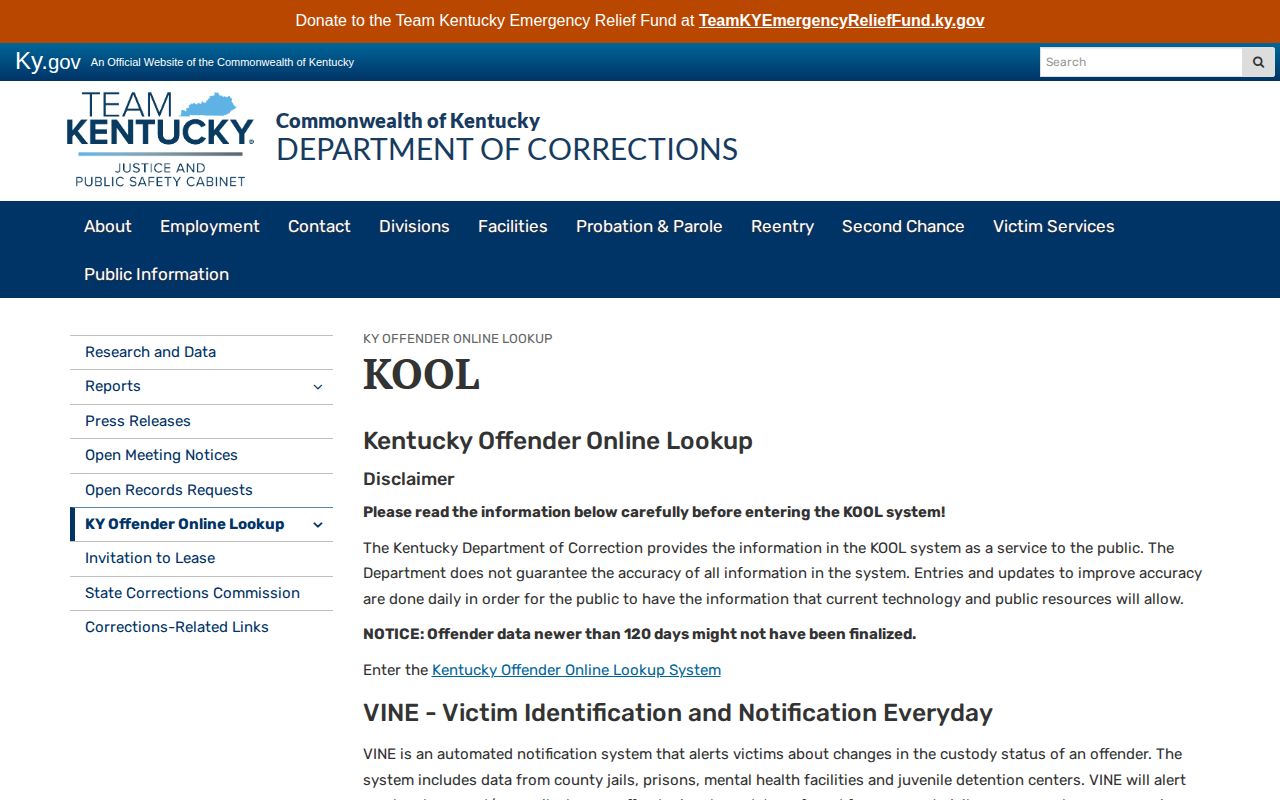
The source confirms KOOL’s role and why its public data should be verified for a current release decision.
Kentucky Credits Affect Fayette Release
KRS 197.045 provides Kentucky’s state sentence-credit framework. It includes prior-confinement credit under KRS 532.120, listed educational credits, approved program credits, good-behavior credit, and exceptional meritorious or emergency credit. Each category has its own conditions. Except for prior-confinement credit, credits may be forfeited or future earning denied for offenses or rule violations.
Qualifying educational achievements can receive 90-day credits. Approved drug-treatment, evidence-based, promising-practice, or life-skills programs can receive up to 90 days each. Discretionary good-behavior credit can reach ten days per month, while exceptional meritorious or emergency credit can reach seven days per month. Those figures describe statutory limits and categories, not a personal calculation.
Consecutive terms are aggregated. Specified sex-offender treatment rules may withhold credits. Jail or prior-custody credit can also be corrected later. The official sentence calculation must combine the right convictions, offense dates, judgment terms, and custody history.
501 KAR 2:060 addresses qualifying state inmates housed in jails and statutory good time under KRS 197.045. It does not justify applying the state-felon formula to every person serving a local misdemeanor sentence. Community Corrections and the sentencing court are the proper sources for a purely local term.
Note: Sentence credits can shorten a calculation, but the public statute alone cannot establish one person’s official Fayette County release date.
Fayette Release and the 85% Rule
Kentucky’s 85% rule is not universal. The current KRS 439.3401, effective July 15, 2026, defines the covered violent-offender categories and the applicable minimum restriction. The offense, conviction date, sentence length, and statutory classification all matter. A charge label alone does not establish that a person must serve 85%.
501 KAR 1:030 supplies detailed first-review schedules, including category and life-sentence rules. Parole eligibility remains distinct from release. The Board may defer, deny, rescind, or later revoke an action. A scheduled hearing may also occur before the eligibility month.
The regulation is visible in the source-linked capture below.
Open the Kentucky parole eligibility regulation.
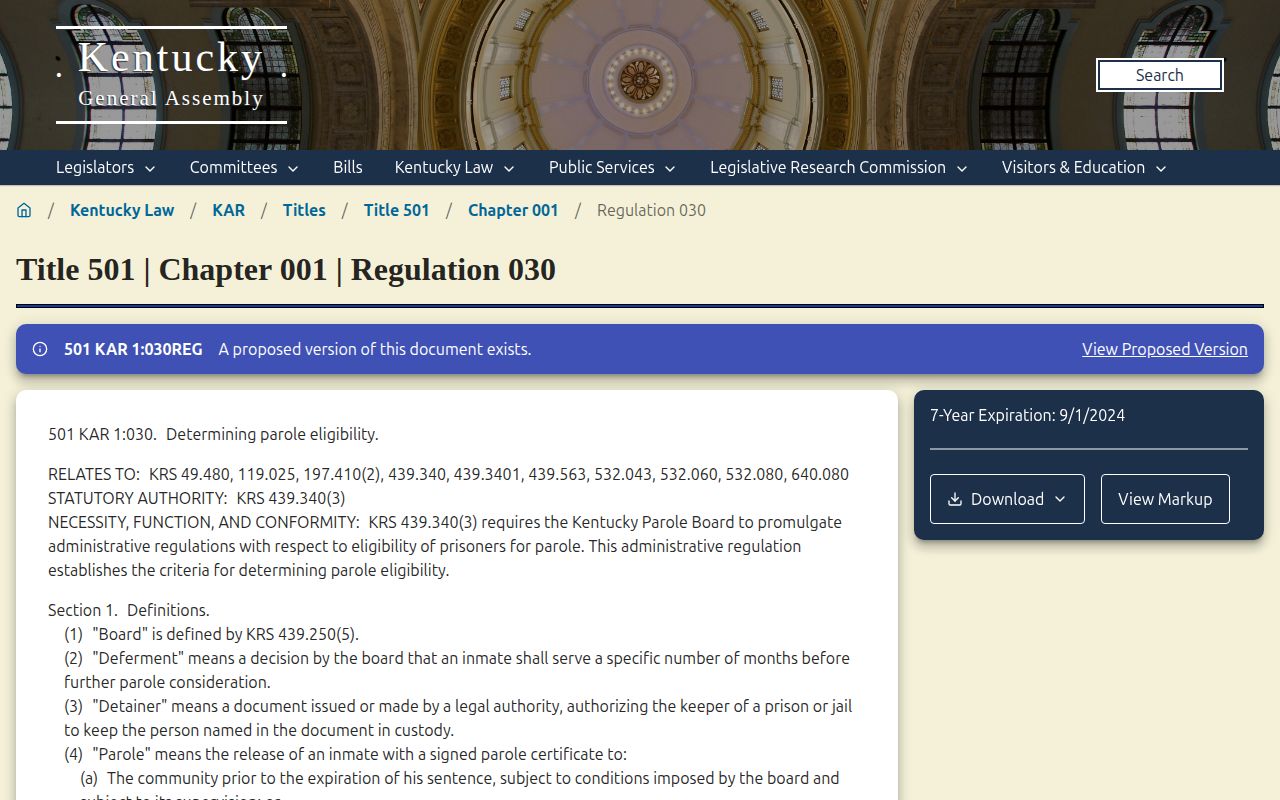
The source shows why a projected release analysis must begin with the person’s governing category, not a broad percentage claim.
What Changes Fayette Release Dates?
A projected date moves when the inputs move. Some changes shorten the calculation, while others extend custody or replace the expected path with supervision. A public portal may update after the official record, so the newest screen does not always tell the whole story.
| Change | Possible effect | Best record |
|---|---|---|
| Jail or prior-custody credit correction | Moves sentence calculation | Official KDOC calculation and judgment |
| Program or monthly credit | May reduce qualifying time | KDOC credit record |
| Credit forfeiture or restoration | Extends or shortens projection | Disciplinary and calculation record |
| Concurrent or consecutive terms | Changes aggregate sentence | Judgments and KDOC calculation |
| Amended judgment or new conviction | Recalculates custody period | Court docket |
| Detainer or outside hold | May prevent community release | Custody and receiving-agency records |
| Parole grant, deferral, rescission, or revocation | Changes route or timing | Parole Board and KOOL |
KRS 439.3406 adds Mandatory Reentry Supervision, generally a six-month supervised period before projected completion for qualifying people not paroled, subject to exclusions. MRS is release under supervision, not unconditional sentence discharge. A KOOL location showing District 9 can reflect that supervised community status.
Why Fayette Release Forecasts Conflict
Fayette readers can encounter an expectedRelease field in the county interface and several separate KOOL labels. The county value concerns a local profile and can be blank. It is not an actual release timestamp. KOOL may display Expected TTS, Minimum Expiration or Good Time Release, parole eligibility, maximum expiration, and proposed release on one state record. These values are not interchangeable.
The official Booked in the Last 48 Hours page is also an admission feed, not a release list. A person disappearing from that page or the current roster does not prove release. The person could have transferred to KDOC, another county, federal custody, or another placement. A data correction can also change visibility.
Resolve a conflict by asking which agency created each date. Community Corrections controls the Fayette jail calculation and release transaction. The sentencing court controls its judgment and orders. KDOC controls the state sentence calculation. The Parole Board controls its decision record. BOP controls a federal release result.
For a state release, reconcile KOOL with VINE and the official calculation. For a Fayette jail discharge, request the release date and time, disposition or destination, and the booking episode from LFUCG Open Records. For the complete branching search, use the Fayette County released inmate search.
Note: A future date answers when release may occur; only the later custody record answers whether it actually occurred.