
Fayette Parole and Probation Compared
Kentucky separates the decision to release from the work of field supervision. The Kentucky Parole Board decides parole matters. The Kentucky Department of Corrections Division of Probation and Parole supervises parole, probation, Mandatory Reentry Supervision, conditional discharge, and certain related statuses in the community. Fayette County belongs to District 9.
Parole is conditional release during a prison sentence. Probation is imposed by a court and generally serves as an alternative to incarceration, although shock probation may follow a short period in custody. Neither status means the case record vanished. Each carries conditions, an end date, and an authority that should be checked in the correct record.
| Point | Parole | Probation |
|---|---|---|
| Authority | Kentucky Parole Board | Sentencing court |
| Typical path | Conditional prison release | Court-ordered community supervision |
| Best public proof | KOOL parole history and Board record | Court judgment and KOOL when listed |
| Fayette field office | KDOC District 9 | KDOC District 9 when KDOC supervises |
- Parole
- Conditional community release before a prison sentence expires.
- Probation
- A court-ordered period in the community subject to stated terms.
- Discharge
- The formal end of a supervision obligation.
- Absconder
- A supervision status alleging loss of contact or failure to report, not a new conviction by itself.
- MRS
- Mandatory Reentry Supervision, a statutory supervised period near the end of some Kentucky sentences.
Verify Fayette Post-Release Supervision
Start with Kentucky Offender Online Lookup, known as KOOL. It covers state prisoners and many people under KDOC community supervision. It is not a full record of every person booked at the Fayette County Detention Center. Use a PID or DOC number when available, or compare the name with date of birth, conviction county, and other identifiers before accepting a match.
- Search KOOL by name, PID, or DOC number and open the matching offender detail.
- Read current location and status together. A prison location means custody; District 9 may indicate community supervision in Fayette.
- Review the parole information table for hearing date, action, deferral, next eligibility, and any proposed release date.
- For parole, compare the result with the Parole Board schedule and obtain the decision sheet when formal proof is needed.
- For probation, inspect the sentencing judgment through the Kentucky court case search. The court order is the source of that status.
- Use District 9 for office navigation. Staff may limit case details disclosed to an unrelated caller.
A KOOL location of District 9 supports the conclusion that KDOC has assigned the case to Fayette supervision. It does not disclose a residence, reporting schedule, or day-to-day location. KOOL also warns that recent information may not be finalized, although KDOC says updates occur daily. Record the retrieval date and ask the agency that created a disputed field to correct it.
Fayette Supervision Runs Through District 9
The official KDOC District 9 page identifies the office that covers Fayette County. It named Josh King as district supervisor at the research date. Personnel and routing can change, so check the live agency page before relying on a name or extension.
KDOC Probation and Parole, District 92008 Mercer Road, Suite 100
Lexington, KY 40511
Telephone: (502) 564-6200
Fax: (859) 246-2176
The District 9 listing is a routing source, not a public case file. A supervised person should follow the reporting instructions on release papers and contact the assigned officer through official channels. Someone checking a public status can ask which office handles general navigation, but should not expect private supervision details.
The official District 9 page can be reviewed in the captured image below.
View the source for Fayette Probation and Parole District 9.
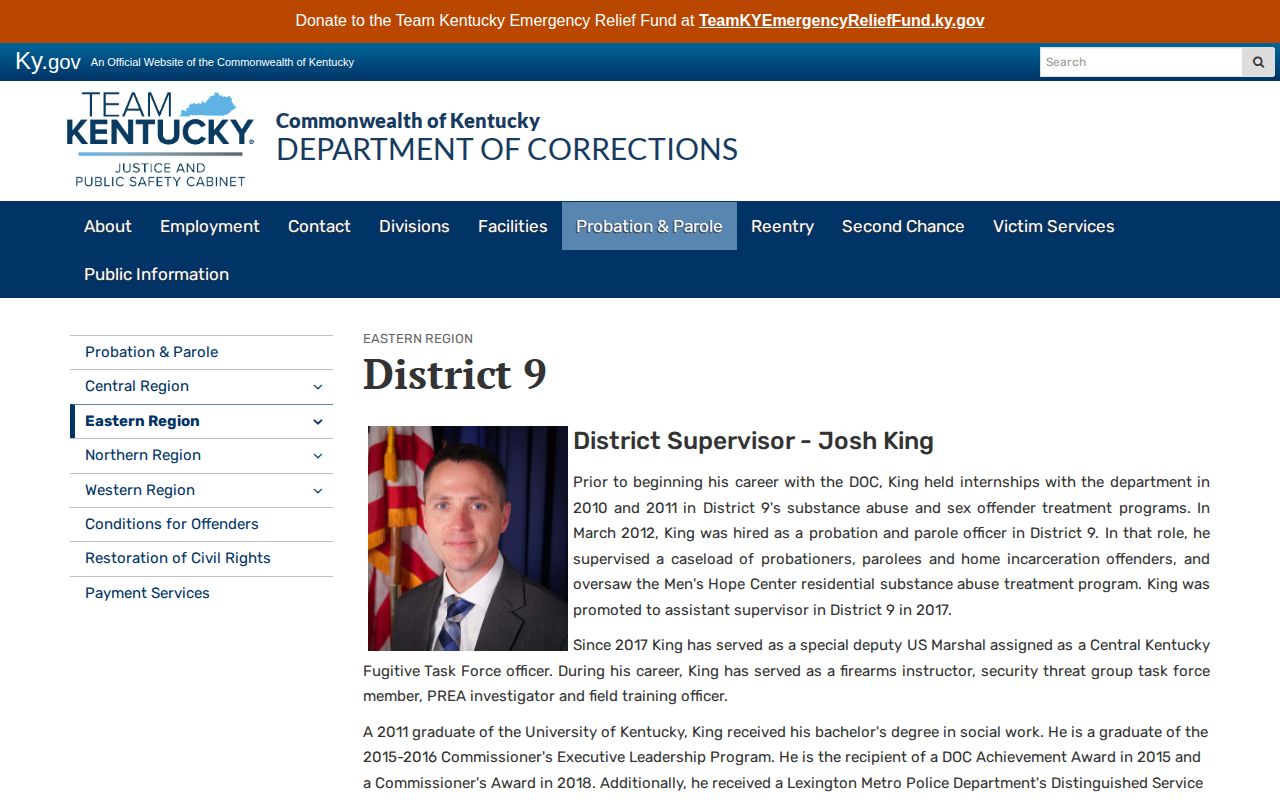
The source confirms the Fayette coverage and provides the office details needed to route a supervision question.
Fayette Parole Hearings and Decisions
The Kentucky Parole Board holds weekly eligibility hearings. Its schedules are published monthly, begin at 8:30 a.m. Eastern, and are updated each Monday. Schedule documents list date, time, and location. Eligibility lists can include the offender name, DOC number, location, and eligibility month. A hearing may take place before the actual eligibility month, so a scheduled hearing is not proof that release occurred.
The public may observe some hearings in person or by video after following Board procedures. File reviews are not open for observation, and an observer does not take part. KOOL is the practical person-level results channel because its Parole Information table may show an action, months deferred, next eligibility, or proposed release date. The Board does not provide a complete standalone decision search. Request the official decision sheet when the distinction matters.
Board terms require care. A recommendation or grant remains subject to final requirements and processing. A deferral postpones review. Denial or serve-out means release was not approved under that action. Rescission withdraws a pre-release action. Revocation ends community parole through the violation process and returns the case to custody. None supplies the physical gate-out time.
The parole eligibility framework is shown in the official regulation capture linked below.
Review 501 KAR 1:030 at the Kentucky Legislature.
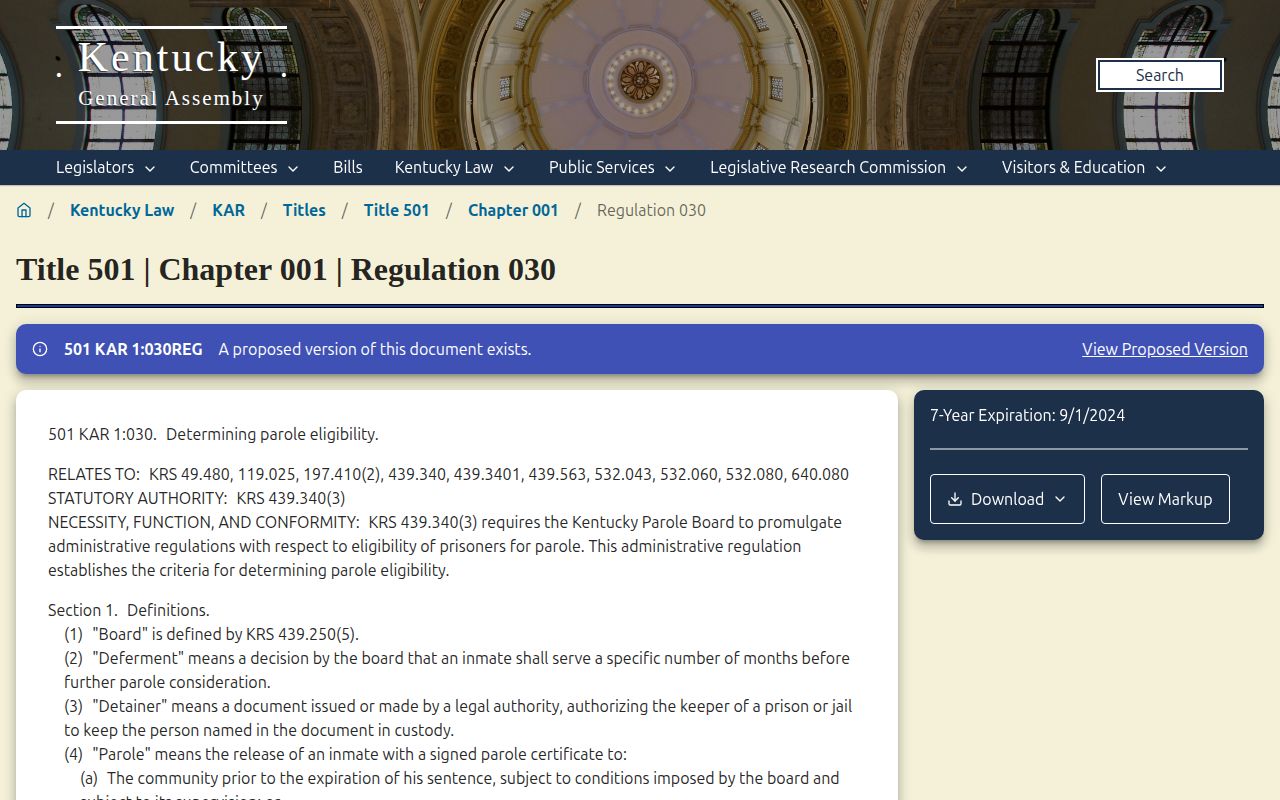
The regulation reinforces why eligibility depends on the sentence and statutory category rather than one universal percentage.
Fayette Supervision Violations and Absconders
Conditions differ by judgment, parole action, and case. They can govern reporting, travel, programs, fees, or conduct, but the signed papers control. Public summaries should not substitute for the actual order. A KOOL escape or abscond indicator should also be read narrowly. It can mean supervision authorities report lost contact or noncompliance and may have started enforcement. It does not prove a new offense, a final revocation, or the outcome of a later hearing.
Verification should combine KOOL, the court docket, and KDOC. A warrant or court entry may explain enforcement. A later Parole Board record may establish revocation. Kentucky VINE can send notices for parole events and upcoming hearings, but an alert is not the legal decision. For a custody-status question after enforcement, compare VINE with the agency now holding the person.
Supervision ends through formal discharge, sentence expiration, or another authorized action. Do not infer discharge merely because an old parole date passed or an online entry changed. The originating record remains the best proof. The broader Fayette County released inmate search explains how jail, court, VINE, state, and federal records fit together.
Note: A proposed parole date, Board recommendation, or old supervision end date does not prove that every release condition was completed.
Fayette Reentry Contacts After Release
KDOC Region 6 identifies a reentry coordinator assigned to District 9 and institutional reentry contacts at Blackburn Correctional Complex. These roles help route transition questions and connect people with established resources. They are not custody-status databases, and they should not be used to guess whether a person was released.
Use the KDOC Region 6 reentry page for the current Fayette contact. A person leaving a state prison should use KDOC release papers, KOOL, VINE, and the assigned supervision office. Someone leaving the Fayette County Detention Center may instead have probation, a court condition, a treatment placement, or no KDOC supervision. The release authority determines the route.
That local split matters. Blackburn is a state prison in Fayette County, while the county detention center is run by Lexington-Fayette Urban County Government. Both have Lexington addresses, yet a Blackburn parole belongs to KDOC and District 9. A jail release record belongs to Community Corrections and the court.
Fayette Property After Supervised Release
Release can leave separate property issues. The LFUCG Property and Evidence guidance sends questions about property confiscated at the detention center to Community Corrections at (859) 425-2700. Police-held personal property follows another process. Identification is required, and another person needs notarized authorization for pickup.
Police personal property may be disposed of after 90 days if unclaimed. Evidence is different. Its release requires permission from the assigned officer or a written court order, and a closed case alone does not release it. These rules concern possession of property, not parole or probation status. District 9 cannot replace the police or jail property custodian.
Keeping the records separate prevents delay. Use District 9 for supervision, Community Corrections for jail property, police Property and Evidence for police-held items, and the court for an order affecting evidence.